
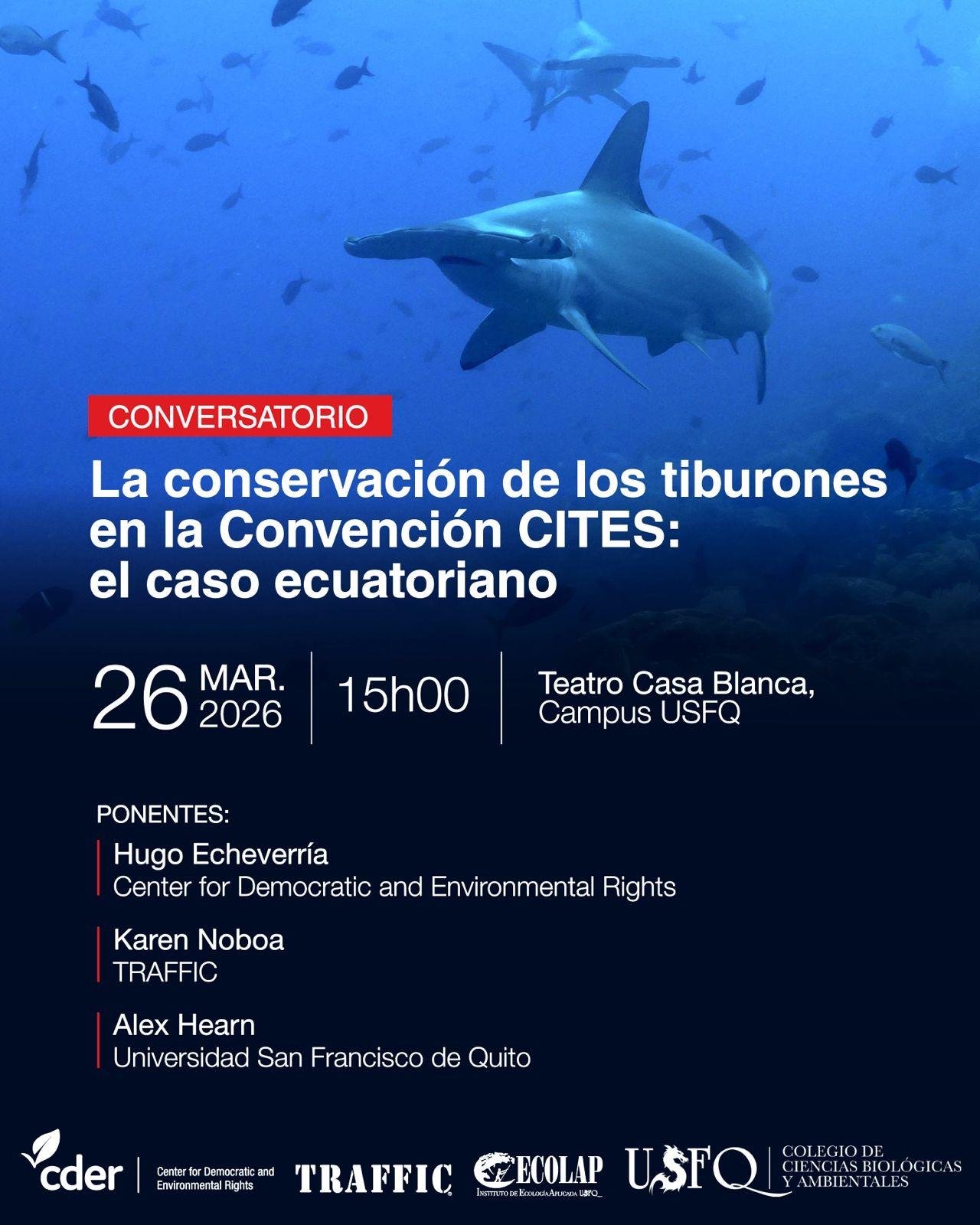
The Center for Democratic and Environmental Rights (CDER) and Universidad San Francisco de Quito are organizing an event at the university on the need for protection of sharks, and the rights of shark species, in the context of the international trade agreement CITES.
The event is sponsored by CDER, TRAFFIC, ECOLAP at the Universidad San Francisco de Quito, and the Universidad San Francisco de Quito.
Speakers will include CDER’s Hugo Echeverría, Karen Noboa of TRAFFIC, and Alex Hearn from the University ECOLAP.
Ecuador is the first country in the world to recognize the rights of nature in its Constitution.
CITES (Convention on International Trade in Endangered Species of Wild Fauna and Flora) is an international agreement aimed at ensuring the global trade of wild animals does not threaten species survival. In force since 1975, 185 countries, including Ecuador, are now Parties to CITES.
In 2024, CITES recommended a global suspension on shark trade from Ecuador. The suspension - which is still in force - involves three shark species that are impacted by "bycatch," the unintentional catching and killing of sharks by commercial fishing. It is well known in Ecuador that "unintentional" bycatch affects shark species protected by CITES, and that the selling of shark parts is very lucrative.
This event will focus on the suspension of shark trade under CITES, and identify conditions necessary to protect shark species in accordance with international standards, as well as Ecuador’s own constitutional principles, rules, duties, and rights, including the rights of nature.
According to CITES, international wildlife trade is estimated to be worth billions of dollars annually. Levels of exploitation of some animal species are high and the trade in them can heavily depleting their populations, and even bringing some species close to extinction. This is the case with sharks.
Approximately 400 species of sharks are found in the world, and 21 species have been listed by CITES as in need of protection from "over-exploitation."
As CITES uses trade measures for its implementation, one recommendation for improving the effectiveness of the Convention is a temporary suspension of trade in specimens of species adversely affected by trade. A recommendation to suspend trade provides a period during which a Party can move from non-compliance to compliance by taking measures, such as on species-protective legislation or reducing illegal trade.
The event will take place on Thursday, March 26, at the Universidad San Francisco de Quito campus in Quito.
Location: Teatro Casa Blanca, Universidad San Francisco de Quito, Quito, Ecuador.
Date: Thursday, May 26. Time: 3-5PM local time.